PASTOR’S DESK
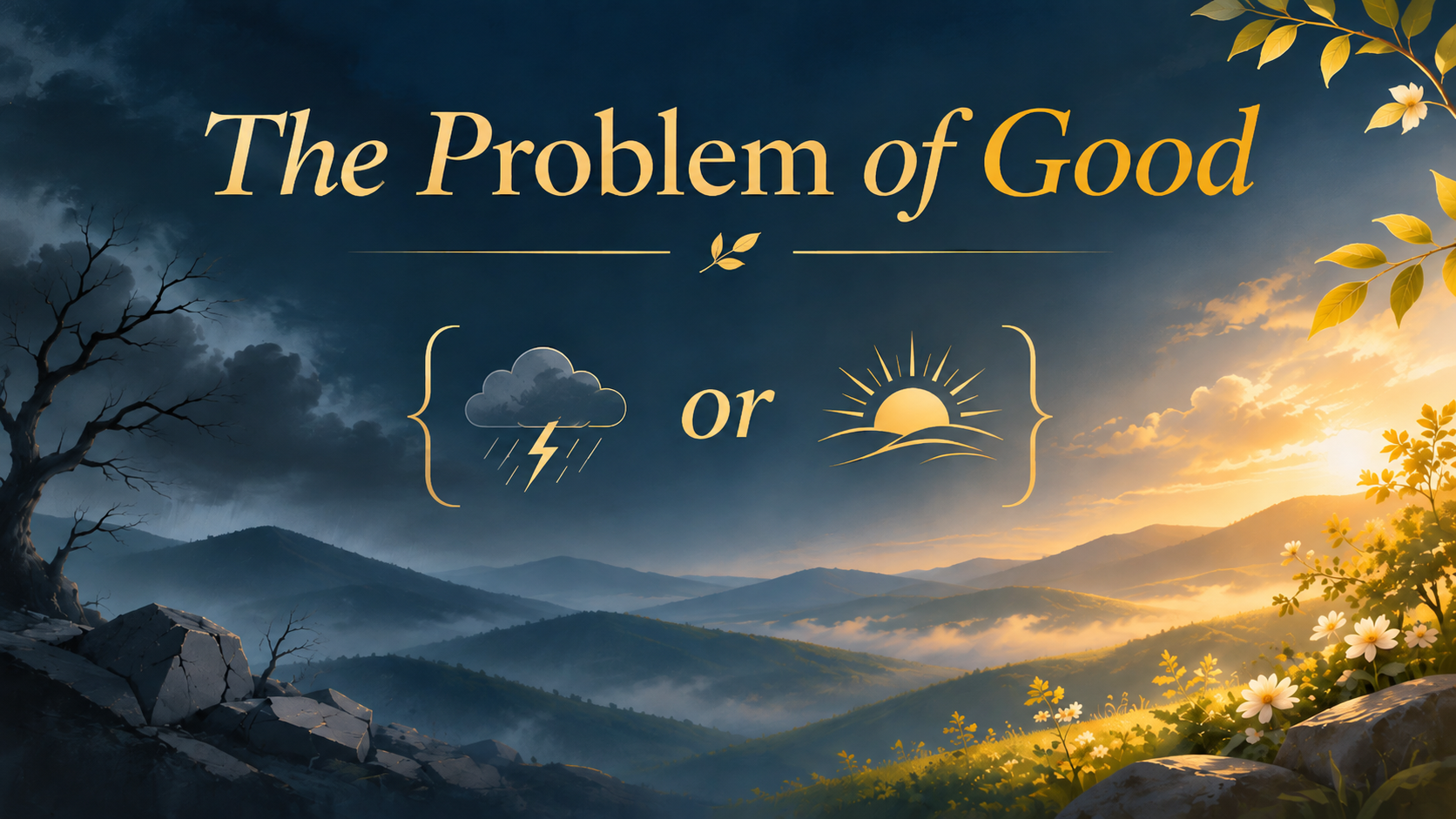
The Problem of Good
We often hear about the problem of evil: “If God exists, why is there so much suffering, cruelty, injustice, and darkness in the world?”
That is a serious question. It really troubles people and challenges their view of God—and sometimes whether He even exists.
But there is another question worth asking that forces us to see the other side of the equation:
If there is no God, why is there so much goodness? So much light?
If reality is, at bottom, only impersonal matter and energy, simply the spinning of atoms, why should there be love, beauty, sacrifice, moral obligation, consciousness, reason, human dignity, and the deep sense that life ought to mean something?
Charles Murray, a longtime public intellectual and writer, tells a story when his wife looked at their new-born daughter and said, “I love her far more than evolution requires.”
Parents know what she means. There is a gut-level affection and commitment they feel that goes far beyond the simple need for “survival.”
This kind of love reveals that a straight line of virtue exists, even in a morally dark world.
C. S. Lewis pointed this out in Mere Christianity. He said he used to argue against God because the universe seemed cruel and unjust. But then he asked himself: where did he get the idea of justice in the first place? “A man does not call a line crooked unless he has some idea of a straight line.”
And that is the problem of good. If there is no God, why is there so much good in the world? Why do we know that some things are truly wrong? Why are we moved by courage and sacrifice when someone takes a bullet or falls on a grenade? Why does beauty matter so much? Why does love feel sacred? Why do we hunger for meaning and truth?
Christianity does not deny the darkness of life, and it has a framework for understanding it.
The problem of evil asks:
If God exists, where does all this darkness come from?
The problem of good asks:
If God does not exist, where did all this light come from?
Let’s be sure to think on both sides of the equation.
Leadership & Church Life
Churches need leadership. The challenge is to provide leadership without becoming authoritarian or descending into aimlessness.
That is one reason we believe God established a plurality of elders for leadership in the church. The New Testament repeatedly pictures local churches with more than one leader: “elders in every church” (Acts 14:23), “bishops and deacons” at Philippi (Philippians 1:1), and “the elders of the church” in James 5:14. Pastoral oversight was shared.
For those who like sports metaphors, I have sometimes thought of my role as more like the quarterback than the head coach. A quarterback communicates and makes decisions as he tries to move the team forward. But he is not the head-coach. He's on the field with everybody else.
The church is not a corporation built around a CEO or command-and-control structures. Scripture gives us more relational pictures: a flock, a body, a household, a family, or even a garden. You shepherd, care, raise, and cultivate.
Elders really do lead, but Peter warns them not to be “domineering over those in your charge” (1 Peter 5:3). Good leadership gives direction while respecting the mind and conscience of the believer.
I want to challenge, teach, and lead alongside the other elders here at Liberty. (I thank God for the team of leaders we have had!) But I do not want to cross the line into controlling another Christian’s conscience or insulting their intelligence.
Church life can be like carrying a lumpy feather mattress up the stairs. You eventually get where you are going, but sometimes the team has to stop, rest, and change tactics.
So be it.
We are not trying to build a machine.
We are trying to cultivate a church where people genuinely love one another and follow Christ together.
And Christ, not the pastor, is the Head of the church.

How Christians Grow
Sanctification is the Bible word for how Christians grow.
Sanctification is the lifelong work God does in you to change you at the heart level—where your thoughts, affections, and motivations lie.
His Spirit works in you to change how you think, what you love, what attracts you, what repulses you, and how you perceive the world. Those inward changes then produce new behaviors, because God is not simply trying to change your outward patterns. He is changing the kind of person you are within.
And this is a process God works in the life of a Christian. Your continuing faith receives God’s daily grace at the root level of life.
Sometimes the steps are so small that you can barely feel them.
Sometimes you may even feel like you're moving backward. But God stays with you, working in you and moving you forward with Him. He promised to never leave you nor forsake you. Proverbs 24:16 says, “For a righteous man may fall seven times and rise again.” The Christian life is not a life without stumbling. It is a life in which God keeps bringing you forward.
Sometimes the steps are much bigger. There are seasons when spiritual growth seems accelerated—when you have what you might call an experience, a rush of progress that feels miraculous.
And then you return to the small steps: Faith. Reliance. Prayer. Scripture. Repentance. Worship. Serving. Forgiving. Showing up. Trusting God when nothing feels spectacular.
Paul wrote that “He who has begun a good work in you will complete it until the day of Jesus Christ” (Philippians 1:6). And as you behold Christ, you are being “transformed into the same image from glory to glory” by the Spirit of the Lord (2 Corinthians 3:18).
You never reach perfection in this life.
But, by God’s grace, you keep going, because there are no perfect Christians. There are only growing Christians.

Introduction to the Book of Job
The book of Job deals with one of the hardest subjects in the Christian life: suffering.
I heard a sermon on Job when I was in my early teens. The preacher said that God allowed Job to suffer because there were certain things Job could learn only through painful trials.
I remember thinking, “Well, I’m going to learn everything I can about God so I don’t have to go through all that!” That was an immature response. But a bit of a shadow lodged in my mind against God because of the idea suffering. That became part of a decades-long struggle with the problem of evil—even while I cared deeply about God.
In a way, Job is a dangerous book. Suffering has caused some people to turn away from the faith altogether.
But Job shows us what to look for.
First, there is the pressure to curse God. The adversary’s claim is that suffering will eventually cause Job to reinterpret God and turn against Him.
Second, there is the danger of surface explanations. Job’s friends offer simplistic, tidy answers because those kinds of answers feel safer than mystery does. But reality is much deeper than their explanations.
And third, there is hope amid unanswered questions.
Near the end of the book, Job says, “I have heard of You by the hearing of the ear, but now my eye sees You” (Job 42:5). That is the great movement of the whole book: Job perceived God and his demand for answers died.
He went from wanting an explanation from God to being confronted with His reality.
And ultimately, the book of Job points to Christ—the truly innocent sufferer, who entered suffering and opened the way to redemption.

Pursuing Authentic Christianity through Simple Faith
At Liberty Church, we often use the phrase “Pursuing Authentic Christianity Through Simple Faith.”
Every word in that statement matters.
* Pursuing reminds us that we have not arrived. There are no perfect Christians, only growing Christians. The Christian life is a lifelong process of becoming more like Christ through what the Bible calls sanctification.
* Authentic means we do not want Christianity to be merely external. It is possible to look religious without truly seeking Christ. That is a danger for all of us. Even talking about “authentic Christianity” can become hypocritical if we begin thinking we are somehow above hypocrisy. So authenticity begins with honesty, regular repentance, and a genuine desire to know Christ.
* Christianity means we are not trying to invent a spirituality of our own. We believe the faith handed down to us from the beginning: the reality of God, Jesus Christ, the Holy Spirit, the Triune God, sin, salvation, miracles, resurrection, judgment, heaven and hell, justification by faith, the ordinances of baptism, and communion: the faith handed down to us rather than one reconstructed to suit our current age.
* Simple means uncluttered. We are not trying to build a religious empire. We are simply a local church—one congregation among thousands—seeking to worship God, teach His Word, love people, and make disciples.
* Faith means trust. We cannot accomplish spiritual work by our own strength. Jesus said, “Without me you can do nothing (John 15:5).” We are still pursuing. Still growing. Still depending on Christ.
That is what we mean by Pursuing Authentic Christianity Through Simple Faith.

Unresolved Tension and the Book of Job
I hate unresolved tension. Most humans do.
Imagine a musician sitting at a piano, playing an octave upward one note at a time, but he stops just before hitting the final note that resolves the octave. Everything in you expects that last note. You want that last note. We wait for the resolution. If it never comes, the unfinished movement leaves you unsettled. It might nearly drive some people crazy!
The question of suffering can feel like that. We want answers, final answers that resolve the questions: Why do we suffer? Why does God allow it?
That’s where the book of Job in the Old Testament comes in. It is all about the question of suffering and the problem of evil. What is frustrating is that this book of the Bible doesn’t clear up the mystery. Job gives us progress without complete resolution.
We often assume that if God has a good reason for suffering, we should be able to see it. But there is a dangerous misstep in reasoning that says, “If I cannot perceive a reason, then there is no reason.”
Alvin Plantinga, one of the most influential Christian philosophers of our day, has thought deeply about what philosophers call the problem of evil and suffering. He points out that answering the logical problem does not require us to know God’s actual reason for every instance of suffering. It is enough to show that God may have a morally sufficient reason for permitting it, even if we cannot see that reason.
Our minds are limited. God’s mind is infinite. There will always be truths beyond our reach.
But God does play a note at the end of Job that rings with resolution and comfort. We will explore that in our current series on the Book of Job, Sunday mornings at Liberty Church.

Why Baptism Matters
Baptism is an essential and joyful step in the life of every believer. It does not remove original sin or save us, but it is the God-given way we publicly identify with Jesus Christ and His people.
The gospel comes first. We are made right with God by grace through faith, not by an outward ritual. Paul points to Abraham as an example: he was counted righteous by faith before he received circumcision (Romans 4:10-11). In the same way, baptism does not create the inward reality of salvation. It is a sign of what God has already done.
That does not make baptism unimportant.
In the New Testament, baptism is expected of those who believe. It is closely connected to conversion because it is the believer’s public confession: “I belong to Christ.” Through baptism, we identify with His death and resurrection and with the visible community of His church.
This is why we should avoid two opposite mistakes. We should not treat baptism as though the ordinance saves us. But neither should we treat it as an optional religious extra.
Faith comes first. Baptism follows as an act of joyful obedience.
There is something beautifully simple about that. A person trusts Christ, then publicly identifies with Him before the church. The inward reality comes first; the outward sign follows.
If you have trusted in Christ but have never been baptized, baptism is not a way to earn salvation. It is the next step of openly saying what faith has already said in the heart: “I belong to Him.”

Why We Preach the Bible Verse by Verse
It All Begins Here
At Liberty Church, we believe the Bible deserves to be heard carefully and in context.
That is why most of our preaching is expositional. In simple terms, we work through a book of the Bible verse by verse, passage by passage, asking what the text actually says and what it means for us.
There are good reasons for that.
First, it keeps the preacher honest. If I choose a new, interesting subject every week, I can easily fall back on the things I already care about, or I can avoid difficult passages. But when we work through a book of the Bible, the Bible sets the agenda.
Right now, we are preaching through the book of Job which is Old Testament poetry, so I'll move more quickly than if I'm preaching through a New Testament letter like Ephesians. Verse-by-verse preaching does not necessarily mean spending the same amount of time on every verse. It means allowing the text itself to set the agenda.
Second, expositional preaching helps us understand Scripture in context. A verse belongs to a paragraph, a book, and a larger story. Instead of beginning with, “What do I want to say?” I begin with, “What is this passage saying?”
Our aim is not to make Christianity complicated. We want to pursue authentic Christianity through simple faith in Christ and serious engagement with Scripture.
The preacher’s job is not to improve upon the Bible. It is to open the text, explain it clearly, and let God’s Word speak.
In a sense, this is also our church-growth plan. We believe that when the Bible is faithfully taught, the Church will appear.
That is why we preach the Bible verse by verse.